
Managing money effectively requires more than earning an income. It involves making informed decisions about spending, saving, debt, investments, and future financial responsibilities. Without a clear plan, even people with regular incomes may struggle to build savings or prepare for unexpected expenses.
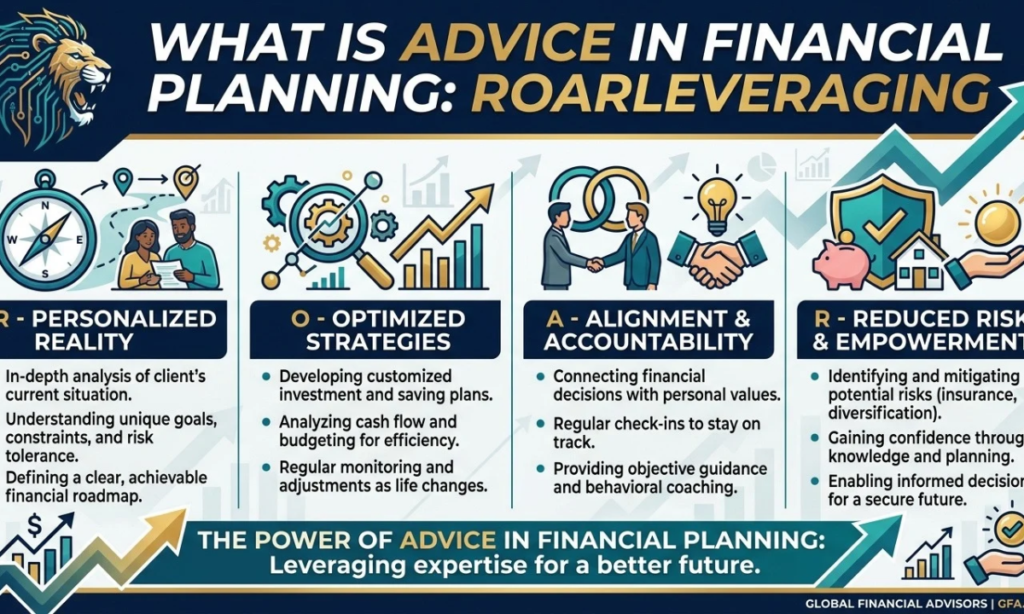
Understanding What Is Advice in Financial Planning RoarLeveraging can help readers explore how financial guidance and practical money-management strategies support better financial decisions. Although RoarLeveraging is not a recognized financial planning term established by the authoritative sources referenced in this article, the underlying subject can be explained through proven financial planning principles.
What Is Advice in Financial Planning RoarLeveraging?
Advice in financial planning refers to guidance that helps individuals understand their financial circumstances and make informed decisions about their money. It may include budgeting, saving, managing debt, choosing investments, preparing for retirement, and protecting against financial risks.
When considering What Is Advice in Financial Planning RoarLeveraging, it is useful to focus on how established financial principles can be applied to everyday situations. Rather than relying on a complicated strategy, individuals can begin by reviewing their income, identifying necessary expenses, and deciding which financial goals deserve priority.
Understanding Financial Planning Advice
What Is Advice in Financial Planning RoarLeveraging helps people organize their finances and decide how to allocate their money. It can come from qualified financial professionals, reputable educational resources, or personal budgeting exercises based on reliable information.
The process typically begins with understanding how much money comes in, how much goes out, and what financial obligations must be met. Once these details are clear, it becomes easier to identify opportunities to save, manage debt, or prepare for future expenses.
What Does RoarLeveraging Mean in Financial Planning?
What Is Advice in Financial Planning RoarLeveraging is not an established financial planning concept identified in the official educational resources referenced for this article. It should therefore not be described as a certified method, recognized investment strategy, or guaranteed way to increase wealth.
In the context of this article, RoarLeveraging can be treated as a descriptive label for applying financial knowledge and available resources to make better money decisions. This is an editorial interpretation, not an official definition.
Why Financial Planning Advice Matters
What Is Advice in Financial Planning RoarLeveraging because everyday decisions can influence a person’s ability to meet both immediate responsibilities and future goals. Without a plan, it can be difficult to identify unnecessary spending, determine how much debt is affordable, or prepare for irregular expenses. A clear financial overview makes these issues easier to recognize.
For instance, a household may discover that its monthly expenses leave almost no room for savings. Reviewing the budget can help identify possible adjustments before an unexpected bill creates additional financial pressure.
How Does Advice in Financial Planning RoarLeveraging Work?
Financial planning generally follows four stages: assessing the current financial situation, setting goals, creating an action plan, and reviewing progress. These stages provide a practical framework for deciding what needs attention first and how available money can support different priorities. The plan should remain flexible because income, expenses, responsibilities, and economic conditions can change.
Assessing Your Current Financial Situation
Begin by collecting information about your income, essential expenses, debts, savings, investments, and other significant financial commitments. Include regular bills such as housing, food, transportation, utilities, education, and healthcare. Remember to account for irregular expenses, including annual fees, repairs, insurance premiums, or seasonal costs.
Next, calculate your approximate net worth by subtracting your liabilities from your assets. For example, suppose you have $5,000 in savings and other assets worth $7,000. Your total assets are $12,000. If your outstanding debts total $4,000, your net worth is $8,000.
Setting Short-Term and Long-Term Financial Goals
Once you understand your current financial position, establish goals that reflect your priorities. Short-term goals may include paying a bill, building initial emergency savings, or reducing a credit card balance. Long-term goals may include purchasing a home, paying for education, expanding a business, or preparing for retirement.
Make each goal specific and measurable. Instead of saying, “I want to save more money,” decide how much you want to save and when you want to reach that amount.
Creating a Personalized Financial Plan
A personalized financial plan translates your goals into practical actions. It should account for your available income, essential expenses, existing debts, savings needs, and future responsibilities.
A basic plan might include:
- Paying essential bills and required debt payments on time.
- Setting aside money for irregular expenses.
- Building an accessible emergency fund.
- Choosing a manageable debt repayment strategy.
- Saving or investing for suitable future goals.
- Reviewing progress and adjusting the plan when necessary.
Key Benefits of Advice in Financial Planning RoarLeveraging
Effective What Is Advice in Financial Planning RoarLeveraging can help people understand their spending habits, organize their savings, manage debt, and prepare for major life expenses. The benefits depend on the quality of the plan and the individual’s circumstances. A budget cannot create extra income by itself, but it can help reveal where money is going and where changes may be possible.
Improving Budgeting and Money Management
A budget helps you compare income with expenses and decide how much money can reasonably be allocated to different priorities. Suppose your monthly take-home income is $2,500 and your recorded expenses total $2,250. You have $250 remaining before accounting for any overlooked costs.
You could decide to direct some of this amount toward emergency savings and reserve the rest for irregular expenses. If the money regularly disappears before the month ends, reviewing your actual spending may reveal why your budget is not working.
Making Better Saving and Investment Decisions
Financial planning helps distinguish money needed soon from money intended for long-term goals. Money reserved for upcoming bills or emergencies generally needs to remain accessible and should not be exposed to unnecessary investment risk. Long-term investment goals may allow for a different approach, depending on the time horizon and the investor’s circumstances.
Before choosing an investment, examine its fees, risks, liquidity, and terms. Do not assume that an investment is appropriate simply because its price has recently increased or someone online recommends it.
Preparing for Unexpected Expenses
Unexpected expenses can include urgent repairs, medical costs, temporary unemployment, or other necessary payments that were not included in the regular budget. Without savings, these situations may force a person to borrow money or delay another important bill. An emergency fund provides a financial buffer and can reduce the need to rely on expensive credit.
Start with an amount you can afford. Even a small, regular contribution can help build the habit of saving. For example, setting aside $25 each week would produce $1,300 in contributions over 52 weeks, assuming no withdrawals and excluding interest.
Building Long-Term Financial Security
Long-term financial security develops through consistent financial habits rather than a single decision. Spending within your means, managing debt carefully, maintaining appropriate savings, and planning for future expenses can improve financial resilience.
For example, someone who saves regularly and increases contributions when income rises may gradually build resources for education, housing, or retirement.
Practical Examples of Financial Planning Advice
Practical examples show how What Is Advice in Financial Planning RoarLeveraging principles can be applied to real-life decisions. The following scenarios use illustrative amounts and are not personalized financial recommendations.
Example of Creating a Monthly Household Budget
Imagine a household earns $3,000 per month after taxes.
Its monthly expenses are:
- Housing: $900
- Food: $450
- Transportation: $250
- Utilities: $200
- Debt payments: $300
- Other essential and personal expenses: $400
Total expenses equal $2,500, leaving $500 before unrecorded or irregular costs. The household might allocate $300 to savings and keep $200 available for irregular expenses. If the household already has urgent unpaid bills or high-interest debt, it may need to adjust this allocation.
Example of Building an Emergency Fund
Suppose a worker has essential monthly expenses of $1,200 and wants to prepare for an unexpected financial setback. They begin by saving $50 each month. After one year, they will have contributed $600, assuming no withdrawals and excluding interest.
If their income increases or expenses decrease, they may decide to increase their monthly contribution. This example demonstrates that emergency savings can begin with a manageable amount. The goal is to establish a consistent habit and gradually build a reserve appropriate for the person’s circumstances.
Example of Managing Debt Effectively
Suppose someone has two outstanding debts. One charges a relatively high interest rate, while the other has a lower rate. After making the required minimum payments on both debts, the borrower has extra money available for repayment.
One strategy is to put the additional money toward the debt with the highest interest rate. This can reduce the total interest paid compared with some alternative repayment approaches, depending on the balances, rates, fees, and payment terms.
Example of Planning for Retirement
Imagine a worker who wants to retire in the future and has started reviewing their financial position. They identify their expected retirement age, current savings, anticipated living costs, and available pension arrangements. They then estimate how much additional money they may need to accumulate.
For illustration, contributing $100 each month produces $1,200 in annual contributions before investment returns, fees, taxes, or withdrawals. Continuing contributions over many years may increase the accumulated amount, but investment returns vary and are not guaranteed. Inflation can also reduce the purchasing power of future savings.
Expert Tips for Better Financial Planning
Good financial planning requires realistic goals, accurate records, consistent habits, and regular reviews. The following practices can help make your financial plan more useful.
Setting Realistic and Measurable Financial Goals
A useful financial goal includes a clear purpose, a target amount, and a reasonable timeline. For example, saving $600 over 12 months requires an average contribution of $50 each month, assuming no withdrawals and excluding interest. If that amount is too difficult to manage, set a smaller target and increase it later when your financial circumstances improve.
Tracking Income and Expenses Regularly
Review your income and spending at least once a month. Bank statements, receipts, budgeting applications, and spreadsheets can help you identify patterns. Look for recurring charges, unexpected fees, and spending categories that repeatedly exceed your budget.
If your income changes from month to month, use a conservative estimate based on past earnings and prioritize essential expenses before making optional commitments.
Diversifying Investments According to Risk Tolerance
Diversification means spreading investments across different assets or holdings instead of depending heavily on one investment. It can reduce certain risks associated with individual investments, but it does not eliminate market risk or guarantee a positive return. Your investment choices should reflect your goals, time horizon, financial circumstances, and ability to tolerate losses.
Money needed soon for essential expenses generally requires a different approach from money being invested for a goal several decades away. Before investing, understand the product, fees, risks, and potential conflicts of interest. Avoid concentrating your money in an opportunity you do not understand.
Reviewing and Updating Your Financial Plan
A financial plan should evolve as your circumstances change. Review it after major life events, such as a change in employment, a move, marriage, the arrival of a child, taking on a major loan, or approaching retirement.
Compare planned expenses with actual spending and check whether your savings goals remain affordable. If your original plan no longer fits your circumstances, adjust What Is Advice in Financial Planning RoarLeveraging rather than continuing to follow unrealistic targets.
Common Financial Planning Mistakes to Avoid
Understanding common mistakes can help you recognize financial problems early and make more informed choices.
Spending More Than You Earn
Consistently spending more than you earn can lead to growing debt and reduce the money available for savings. Start by comparing actual income with essential and discretionary expenses. If spending exceeds income, identify changes that are realistic and sustainable. Possible actions include reviewing subscriptions, reducing avoidable purchases, negotiating certain bills where possible, or exploring additional income opportunities.
However, when essential living costs already exceed available income, cutting small optional expenses may not solve the problem. In that situation, consider whether additional income, assistance programs, affordable services, or qualified debt support may be available.
Ignoring Emergency Savings
Using all available money for everyday expenses leaves little room for unexpected costs. An emergency fund can help cover urgent expenses without immediately relying on credit. Begin with a manageable contribution and gradually increase it when your budget permits.
Keep emergency money separate from routine spending where practical, and review your savings target as your responsibilities change. If you face overdue essential bills or expensive debt, balance the need to save with the urgency of those obligations.
Making Investment Decisions Without Research
Investing without understanding an opportunity can expose you to unnecessary risks. Research the investment, its costs, withdrawal conditions, potential losses, and the organization offering it. Verify relevant registrations or licenses through the appropriate regulator.
Be cautious about pressure to invest immediately, promises of guaranteed high returns, and opportunities that claim to offer substantial profits with little risk. Do not invest money simply because a friend, influencer, or online advertisement recommends it. Make sure you understand what you are buying and how it fits your financial goals.
Failing to Plan for Future Financial Needs
Focusing exclusively on current expenses can leave future priorities underfunded. Consider foreseeable needs such as education, housing, healthcare, family responsibilities, and retirement. Estimate when each expense might occur and determine how you could prepare for it.
You do not need to predict every future cost precisely. A reasonable estimate provides a starting point that can be updated as circumstances change. Review your plan when prices, income, or responsibilities change so that your financial priorities remain realistic.
How to Get Started With Financial Planning RoarLeveraging
Getting started does not require expensive software or advanced financial knowledge. A notebook, spreadsheet, or suitable budgeting tool can help you organize your finances and work toward achievable goals. In this article, What Is Advice in Financial Planning RoarLeveraging to applying established financial planning habits, not to a separately verified financial method.
Evaluating Your Current Financial Position
List your income, essential expenses, debts, savings, and other significant financial commitments. Use actual records whenever possible. Include irregular bills and annual costs so you do not overestimate the amount available for saving. Identify the most urgent financial priority. It might be bringing spending under control, catching up on essential payments, addressing high-interest debt, or starting an emergency fund.
Choosing the Right Financial Planning Tools
Choose tools that make your financial information easier to organize and understand. A spreadsheet can track income, expenses, savings contributions, and debt balances. A budgeting application may offer transaction categorization, spending summaries, or bill reminders.
Calculators can help estimate savings contributions or illustrate how hypothetical investment returns might affect a future balance. Their results depend on the assumptions entered and should not be treated as guarantees.
Knowing When to Consult a Financial Adviser
Professional advice may be useful when you face complicated decisions involving investments, retirement, taxes, substantial debt, insurance, or major financial commitments. Before choosing an adviser, ask about their qualifications, experience, services, fees, and any potential conflicts of interest. Verify their credentials or registration through the relevant regulatory or professional body.
Monitoring Progress and Adjusting Your Plan
Review your financial plan regularly to determine whether it remains practical. Compare actual spending with your budget, check changes in debt balances, and confirm that your savings contributions are affordable. If an unexpected expense disrupts your progress, revise your plan and establish a realistic next step. Missing a savings target does not mean you must abandon the entire plan.
Conclusion
Understanding What Is Advice in Financial Planning RoarLeveraging starts with learning how to manage money wisely, set realistic financial goals, and prepare for future needs. Financial planning can help individuals improve budgeting, build emergency savings, manage debt, and make informed decisions about saving and investing.
Although RoarLeveraging is not an established financial planning term identified in the sources reviewed, the principles discussed in this guide provide a practical foundation for making better financial decisions.
FAQs
1. What Is Advice in Financial Planning RoarLeveraging?
What Is Advice in Financial Planning RoarLeveraging refers to using practical financial planning principles to manage money, set goals, and prepare for future expenses.
2. Why Is Financial Planning Advice Important?
Financial planning advice helps people create budgets, manage debt, build savings, and make informed financial decisions. It also supports long-term goals, such as buying a home, funding education, or preparing for retirement.
3. How Can Beginners Start Financial Planning?
Beginners can start by calculating their income, tracking expenses, and identifying their short-term and long-term financial goals. Creating a realistic budget and building an emergency fund are practical first steps toward better money management.
4. What Are the Main Benefits of Financial Planning Advice?
The main benefits include improved budgeting, better saving habits, more informed investment decisions, and preparation for unexpected expenses. A well-organized financial plan can also help individuals work toward greater financial stability over time.
5. When Should You Consult a Financial Adviser?
You may consult a qualified financial adviser when planning for retirement, managing complex debt, investing, or making major financial decisions. Choose an adviser whose qualifications, fees, and services are clear and appropriate for your financial needs.