

Intraday trading, often called day trading, involves buying and selling securities within the same trading day in an attempt to benefit from short-term price movements. It can appear attractive because positions may be opened and closed within hours or even minutes. However, speed does not make trading easy. Day trading is considered a high-risk activity, and substantial losses can occur in a very short period.
That is why good intraday trading advice should focus less on promises of quick profits and more on preparation, research, discipline, risk management, and realistic expectations. There is no trading strategy that can guarantee a profit on every trade.
The phrase “profitable intraday trading advice 66unblockedgames.com” also needs some context. The domain has pages associated with this phrase, but the existence of a trading-related page does not establish that the website is a regulated broker or licensed financial adviser. Readers should evaluate financial information independently rather than assuming that every claim published online is professionally verified.
What Is Intraday Trading?
Intraday trading is a short-term trading approach in which a trader buys and sells securities during the same trading day. The objective is generally to attempt to benefit from short-term price changes rather than hold the position as a long-term investment.
How Intraday Trading Works
An intraday trader begins by identifying a security and assessing its current market conditions. The trader may examine price movements, trading activity, news, charts, or other information before deciding whether a particular opportunity fits the chosen strategy.
A complete trading decision involves more than choosing an entry point. Before entering a position, a trader should understand the potential downside, determine how the position will be managed, and have a reason for exiting.
This is particularly important because markets can move quickly. Day trading requires close attention and can involve rapid decision-making, while leverage can make losses occur faster and become larger.
Intraday Trading vs. Long-Term Investing
Intraday trading and long-term investing have different objectives and time horizons. A long-term investor may hold a diversified portfolio for years and focus on longer-term financial goals. An intraday trader instead attempts to capitalize on shorter-term price movements and generally spends considerably more time monitoring the market.
Neither approach should automatically be considered superior. The important point is that intraday trading should not be treated as simply a faster version of investing.
Why People Choose Intraday Trading
Some people are attracted to intraday trading because they prefer active participation in financial markets. Online brokerage platforms have also made frequent trading easier to access.
Frequent intraday traders may attempt to profit from relatively small price movements. However, easier access does not make trading simple or safe. A trading account provides access to the market, but it does not provide the knowledge, strategy, or discipline required to manage risk successfully.
What Makes Intraday Trading Potentially Profitable?
The word “potentially” is important. Intraday trading can produce gains, but no legitimate strategy can guarantee profits. A sensible approach is therefore to focus on having a repeatable process rather than searching for a guaranteed winning formula.
Understanding Market Trends
Market prices can move upward, downward, or sideways, and conditions can change during a trading session. Traders may use charts, price information, news, and other market data to understand what is happening.
Recognizing a trend does not mean predicting the future with certainty. A price movement that looks strong at one moment can reverse unexpectedly. This is why a trading plan should account for both favorable and unfavorable outcomes.
Choosing the Right Trading Opportunities
A disciplined trader does not need to participate in every market movement. Instead, a strategy can define specific conditions that must be present before a trade is considered. If those conditions are absent, waiting may be preferable to forcing a trade.
Frequent activity can create additional costs and additional opportunities for mistakes. More trades do not automatically mean more profitable trades.
The Importance of Timing and Discipline
Intraday markets can change quickly, making timing an important part of any short-term strategy. But timing should not simply mean trying to guess the exact top or bottom.
Discipline means following predetermined rules instead of allowing excitement, fear, frustration, or the desire to recover losses to control the next decision. A written plan can help traders remain consistent when market conditions become stressful.
Setting Realistic Profit Expectations
One of the strongest pieces of profitable intraday trading advice 66unblockedgames.com is also one of the simplest: avoid believing claims that make trading sound risk-free.
Promises of high returns with little or no risk should always be treated with skepticism. A realistic trading plan accepts that losing trades are possible.
Instead of asking how to guarantee a profit, traders should ask whether a strategy has clearly defined rules, manageable risk, reasonable costs, and evidence supporting its use.
Profitable Intraday Trading Advice 66unblockedgames.com
The exact phrase appears online in connection with 66unblockedgames.com. However, readers should distinguish the keyword from independently verified financial expertise.
A website carrying a trading-related article or page is not automatically evidence that it is a regulated broker, licensed adviser, or professional financial institution.
Create a Clear Trading Plan
A trading plan gives each decision a defined framework. It can specify what type of market conditions the trader is looking for, what would qualify as an entry, what would cause an exit, and how much risk is acceptable.
The purpose is not to predict every market movement. Instead, it helps prevent decisions from being made randomly or emotionally.
Research the Market Before Entering a Trade
Research should take place before money is committed. Depending on the market and strategy, this can involve examining price behavior, relevant company or economic news, trading activity, and other information that could affect the security. Understanding an investment before committing money is an important part of responsible decision-making.
Use Technical Indicators Carefully
Technical indicators can help traders organize and interpret market data. Examples include moving averages and momentum-related indicators. However, an indicator should not be presented as a guaranteed prediction tool. A technical signal can be wrong, particularly when market conditions change.
The better approach is to understand what an indicator measures, how it fits into the overall strategy, and what risks remain even when the signal appears favorable.
Avoid Emotional Trading
Emotional trading can turn one poor decision into several. For example, a trader who experiences a loss might immediately enter another position simply to recover the money. That new trade may have little connection to the original strategy. A written plan and predetermined risk limits can help reduce this type of reaction.
Know When to Enter and Exit
A trade should have a reason for both entering and leaving. Before opening a position, traders can establish the conditions that would support the trade and the circumstances that would invalidate the original idea. This does not eliminate losses, but it can make the decision-making process more consistent.
Popular Intraday Profitable Intraday Trading Advice 66unblockedgames.com Strategies

Different traders use different approaches, and no single strategy is guaranteed to work in every market environment.
Trend-Following Strategy
Trend-following attempts to participate in an established market direction. A trader may look for evidence of sustained upward or downward movement and then use predetermined rules to decide whether the situation fits the strategy. The main limitation is that trends can weaken or reverse. A trend-following setup therefore still requires risk controls.
Breakout Trading Strategy
Breakout trading focuses on situations in which price moves beyond a previously observed level or trading range. The attraction is that a genuine breakout may be accompanied by strong price movement. The risk is that a breakout can fail and the price can move back through the previous level.
Momentum Trading Strategy
Momentum trading attempts to participate in strong price movements. Momentum can be attractive because price may move rapidly, but that same speed creates risk. A sudden reversal can occur before a trader has time to respond as expected. This makes entry discipline and risk management particularly important.
Support and Resistance Strategy
Support and resistance refer to price areas where traders observe previous buying or selling activity. These levels can be used to organize possible trading scenarios. They should not, however, be treated as guaranteed barriers. Market prices can move through previously important levels, especially when new information changes investor expectations.
Risk Management in Intraday Trading
Risk management should be considered before looking for potential profits. Leverage can increase potential gains, but it can also magnify losses. In some circumstances, leveraged trading can result in losses greater than the amount initially invested.
Why Stop-Losses Are Important
A stop-loss can form part of a trader’s predetermined exit plan when a position moves against the intended scenario. A stop order does not make a trade risk-free, and execution can depend on market conditions and order type. Nevertheless, having a predefined exit can help prevent a trader from holding a losing position indefinitely simply because they hope the price will eventually recover.
Managing Position Size
Position size determines how much capital is exposed to a particular trade. Keeping individual positions appropriately sized can limit the financial effect of an unfavorable price movement. The correct amount depends on the trader’s circumstances, strategy, and risk tolerance.
Understanding Risk-to-Reward Ratios
Risk-to-reward analysis compares the amount a trader is prepared to lose with the potential gain being targeted. For example, a hypothetical trade that risks $100 while targeting $200 has a planned 1:2 risk-to-potential-reward relationship.
Avoiding Excessive Leverage
Leverage deserves particular caution because it can increase the size of both gains and losses. This is particularly important for inexperienced traders. Before using margin, traders should understand the applicable requirements, interest or financing costs, potential losses, and the rules of their brokerage account.
U.S. traders should also avoid relying on outdated information about day-trading margin requirements because regulatory requirements have changed in 2026.
Practical Tips Profitable Intraday Trading Advice 66unblockedgames.com
Beginners should prioritize learning and risk awareness rather than trying to generate immediate income.
Start With Proper Education
Before placing trades, learn the mechanics of the market and the specific products being considered. Understanding order types, costs, volatility, margin, and the risks of the chosen product is more useful than simply memorizing a list of “winning” signals.
Practice Before Using Real Money
Practice or simulated trading can help beginners understand how a strategy works and become familiar with placing and managing orders. However, simulated results should not be treated as proof of future real-money performance. Actual trading introduces financial consequences and emotional pressure that practice may not reproduce.
Keep a Trading Journal
A trading journal can record:
- Why the trade was entered
- The planned entry and exit
- The amount of risk
- The actual result
- Whether the trading rules were followed
Over time, this information can help identify repeated mistakes and weaknesses in a strategy.
Review Your Results Regularly
A single winning or losing trade says very little about whether a strategy is useful. Regular review can reveal patterns. A trader might discover, for example, that certain market conditions consistently produce poor results or that many losses come from trades taken outside the original plan.
Common Intraday Trading Mistakes to Avoid
Recognizing common mistakes can help beginners build more disciplined habits. Entering a trade simply because a price is moving is not a complete strategy. A trader should understand why the trade is being considered, what conditions support the idea, and what would make the trade no longer attractive.
Chasing Quick Profits
The desire to make money quickly can encourage excessive risk. Claims that promise unusually high returns with little or no risk should be viewed with extreme caution. There is no legitimate method that can guarantee profits without risk.
Overtrading
Overtrading means taking more positions than the strategy or circumstances justify. Frequent trading can increase exposure to market risk and can also increase transaction-related costs. More activity does not automatically improve performance.
Ignoring Trading Costs
A strategy must be evaluated after considering its costs. Depending on the product and brokerage arrangement, costs can include commissions, spreads, margin-related expenses, and other charges. A trade that appears attractive before costs may be much less attractive after those expenses are included.
Making Decisions Based on Fear or Greed
Fear may encourage a trader to exit too quickly, while greed may encourage excessive risk or ignoring an established exit rule. A disciplined process does not eliminate emotions, but it can prevent emotions from becoming the primary trading system.
How to Evaluate Online Intraday Trading Advice
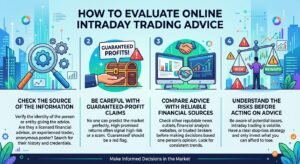
The internet contains an enormous amount of financial information, but accessibility does not equal reliability.
Check the Source of the Information
Look at who published the information, whether the person or organization can be independently identified, and whether claims are supported by credible evidence. For financial services, investors should check whether relevant firms or professionals are properly registered where applicable.
Be Careful With Guaranteed-Profit Claims
A promise of guaranteed trading profits is a major warning sign. There is no such thing as a genuinely risk-free trading strategy that guarantees high returns. Legitimate trading involves uncertainty and the possibility of loss.
Compare Advice With Reliable Financial Sources
Do not rely on a single blog post, social-media account, video, or anonymous trading community for an important financial decision. Compare claims against primary sources such as financial regulators, established financial institutions, and recognized educational resources.
Understand the Risks Before Acting on Advice
Good financial information should explain both potential benefits and potential losses. If an article focuses entirely on winning trades while ignoring leverage, costs, volatility, liquidity, and the possibility of losing money, it provides an incomplete picture.
Is Intraday Trading Suitable for Everyone?
No. Intraday trading involves substantial risk and may be inappropriate for people with limited resources, limited trading experience, or low tolerance for financial losses.
Understanding Your Risk Tolerance
Before considering speculative trading, a person should understand how much financial loss they could realistically withstand. Money required for essential living expenses, emergency needs, or other important obligations should not be treated as disposable trading capital.
Considering Your Experience and Available Time
Intraday trading can require frequent monitoring and rapid decisions. Someone who does not understand the market, the product being traded, or the risks of margin may be poorly positioned to manage an active trading strategy. Experience and available time should therefore be considered before choosing this approach.
Knowing When to Step Away From the Market
Not trading is sometimes the most disciplined choice. If market conditions do not match a strategy, the potential risk is too high, or emotions are affecting decisions, stepping away can prevent an unnecessary trade. There is no requirement to participate in every market movement.
Final Thoughts
The strongest interpretation of profitable intraday trading advice 66unblockedgames.com should be based on education rather than promises of easy money.
Intraday trading involves short-term buying and selling and can expose traders to substantial losses in a short period. Leverage and margin can increase those risks further.
A responsible approach starts with understanding the market, developing a clear trading plan, researching potential positions, managing position size, controlling risk, accounting for costs, and reviewing performance honestly. Beginners should also be particularly skeptical of websites, advertisements, influencers, or online communities that promise guaranteed returns.
FAQs About Profitable Intraday Trading Advice 66unblockedgames.com
1. What is profitable intraday trading advice?
Profitable intraday trading advice focuses on planning, market research, disciplined execution, and careful risk management. No strategy can guarantee profits, so traders should always understand the possibility of losses.
2. Is intraday trading profitable for beginners?
Intraday trading can be difficult for beginners because markets can move quickly and losses may occur rapidly. New traders should learn the fundamentals, practice carefully, and understand the risks before using real money.
3. What is the best strategy for intraday trading?
There is no single best strategy because market conditions and individual trading goals vary. Trend-following, breakout, momentum, and support-and-resistance approaches are commonly used but all carry risk.
4. How can traders reduce intraday trading risks?
Traders can manage risk by using appropriate position sizes, setting clear exit rules, and avoiding excessive leverage. They should also avoid risking money needed for essential expenses or financial obligations.
5. Is 66unblockedgames.com a reliable source of trading advice?
The website has pages associated with the phrase “profitable intraday trading advice,” but that alone does not establish financial expertise or regulation. Readers should verify financial information through credible and independent sources before acting on it.